Facing complex problems often changes the way we think, and this is where the psychology of handwriting becomes relevant. Have you ever noticed that the harder you think about a problem, the more complicated it feels? It is as if your mind enters a narrow tunnel where only one thing exists, it is the problem itself. The book It’s Not About the Shark by David Niven speaks directly about this phenomenon. It explains how the way we view a problem determines how much impact it has on our lives.
In the book, Niven explains that when we focus too much on a problem, we are not actually solving it. Instead, we make it appear bigger than it really is. The issue grows in our mind, while opportunities, solutions and alternative perspectives slowly disappear from our awareness.
He emphasizes that excessive fear, often caused by constantly staring at the problem which does not create real change. Fear only narrows our thinking space. And when our thinking space becomes narrow, creativity decreases and productivity drops.
Instead of searching for solutions, we become busy imagining the worst case scenarios. Niven reminds us that the tighter we “hold” a problem in our mind, the greater the psychological pressure we feel. Over-focusing on difficulties traps us in repetitive thinking patterns. The mind becomes rigid, defensive and even unable to see perspectives beyond the threat in front of us. Interestingly, this thinking pattern is often reflected in something very personal, our handwriting.
When the Mind Is Under Pressure, Handwriting Changes
Handwriting is not merely letters on paper. It is the result of coordination between soft motor skills and cognitive planning. When someone is under pressure and overly focused on a problem, certain handwriting tendencies often appear.
1. Pessimism
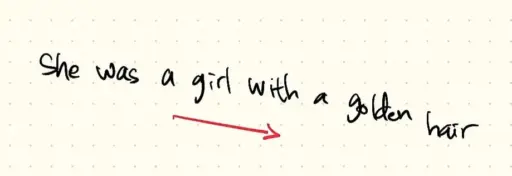
downward handwriting
One common example is a baseline that slopes downward toward the right. Individuals with this pattern tend to focus more on the negative side of situations. Their thoughts may circle around one perspective only, especially when facing difficulties. As a result, their mental energy becomes concentrated on the problem instead of exploring other possibilities.
This condition aligns with Niven’s idea, when fear dominates, our thinking system shifts into survival mode rather than growth mode. The brain becomes more concerned with avoiding threats than creating solutions.
On the other hand, when someone begins shifting their focus from “the problem” to “possibilities,” changes can often be seen in their handwriting like this,
2. Will Power
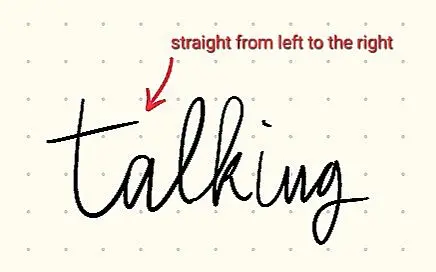
“t” bar straight from left to right
The crossbar of the letter “t” may appear firm and straight, pulled clearly from left to right.
This kind of stroke suggests directed energy and determination. It reflects an ability to channel focus more effectively. Instead of entering survival mode, the individual moves toward growth. They are able to redirect their attention and avoid being trapped in the problem itself. This gives them space to consider alternatives. Such a condition is in line with the solution Niven encourages.
Shifting Focus, Transforming Thought Patterns
One of the strongest messages in the book is that misplaced focus limits the way we see the world. When our attention is fixed on a single point the problem itself, then we unconsciously close the door to other perspectives. That is what makes problems feel more complex. Not because they are objectively larger, but because our thinking capacity becomes smaller.
Niven does not suggest ignoring problems. Instead, he invites readers not to make problems the center of their lives. There is a significant difference between acknowledging a difficulty and allowing it to control our way of thinking.
When we shift our focus from fear to possibility, from threat to learning opportunity, our cognitive system works differently. Creativity re-emerges. Mental energy is no longer exhausted by imagining failure.
In this sense, handwriting can act as a small mirror of our mental process. It does not judge, but it records. It shows when we are under pressure and when we begin giving ourselves space to think more broadly.
Because Problems Are Not the Center of Our Lives
It’s Not About the Shark carries a simple yet profound message. Niven mentions that thinking about the problem first can make us significantly more likely to fail. When our mind is filled primarily with the problem, there is less room for other perspectives. Our lives are not determined by the problems we face, but by how we respond to them. When we stop placing problems at the center of our attention, we reopen possibilities that were previously hidden by fear.
And perhaps this is where handwriting becomes a meaningful reflective tool. It helps us see whether our mind is trapped in pressure or beginning to expand again. Often, meaningful change starts from something small, the way we choose to look at a problem.
Interested in exploring more deeply how handwriting reflects the way we respond to challenges? The Comprehensive Course may be the next step in understanding yourself with greater clarity and mastery.