How Meditation Influences the Way We Express Ourselves
Have you ever noticed that your handwriting changes when you feel tired, anxious, or unexpectedly calm? Sometimes each stroke feels heavier when emotions begin to accumulate. At other times, the lines appear lighter and more fluid when the mind feels clear. These subtle shifts reveal the quiet connection between meditation and handwriting, where the way we write often reflects our inner state.
Meditation is not merely sitting quietly with closed eyes. It is a practice of awareness which is a way to recognize what is happening within ourselves before it appears as words, actions, or even strokes of ink on paper. At its core, every expression is a reflection of our internal condition.
Handwriting Is Brainwriting
In the field of graphology, there is a fundamental principle: Handwriting is Brainwriting. This implies that handwriting is far more than a mere physical exertion of the fingers and wrist but the result of neurological processes in the brain.
Research in neuroscience shows that handwriting is a complex activity involving cognitive planning, emotional processing and fine motor control. During the act of writing, the brain simultaneously manages:
- Cognitive planning, organizing thoughts before they are translated into written language
- Emotional processing, internal emotional states that influence pressure, rhythm and movement
- Fine motor control, precise coordination between fingers, wrists and muscles
- Psychological responses to stress, the nervous system’s reaction to pressure or tension
Because of this, handwriting can be seen as the output of this entire system. When the mind is rushing, writing may become faster and less structured. In other words, before ink touches the paper, the mind has already begun working. The condition of the mind, therefore, becomes something that can be trained and one way to cultivate it is through meditation.
The Connection Between Meditation and Handwriting
Meditation helps us become aware of what usually happens without our notice. We often remain oblivious to our own anxiety or the moments we instinctively become defensive. Yet the body knows. The nervous system knows and sometimes, handwriting quietly leaves traces of it.
According to research reported by Harvard Medical School, mindfulness meditation can produce measurable changes in the brain after consistent practice. In a study involving an eight-week mindfulness program, brain scans showed increased gray matter in areas related to learning, memory, self-awareness, empathy and emotional regulation.
Interestingly, the same research also observed reduced gray matter density in the amygdala, a region of the brain strongly associated with fear, anxiety and stress responses. These structural changes were correlated with participants reporting lower levels of stress. This suggests that meditation does not only help us feel calmer in the moment. Over time, it can reshape how the brain processes emotions and responds to pressure.
By practicing meditation regularly, we learn to observe without immediately reacting. Gradually we begin to recognize patterns there are when we are easily triggered, when we feel under pressure and when we feel stable and clear.
Through this awareness, the way we respond to the world can gradually change. Our reactions become less automatic and more reflective. In the context of meditation and handwriting, a calmer and more regulated mental state can sometimes be reflected in the overall flow of writing. Movements may feel more balanced, spacing more natural, and the rhythm of writing less rushed.
This does not happen because we deliberately try to control how the writing looks. Rather, it happens because of the internal system such as mind, emotion and body which works in greater harmony. In other words, handwriting may quietly mirror the state of our inner regulation at a particular moment.
Expression as a Reflection of the Inner State
We often think of expression as something directed outward. In reality, expression always begins from within. The way we speak, the way we respond to conflict, the way we make decisions, even the way we write. All of these emerge from our inner state at that moment.
Meditation helps us realize that thoughts are not something we must always follow. Emotions are not something we must always release immediately. Within the sacred space between stimulus and response, the true quality of our expression takes shape.
When the inner state becomes calmer, expression becomes more directed. When the mind becomes clearer, communication becomes more mature. As a result, handwriting may also change as our internal regulation shifts.
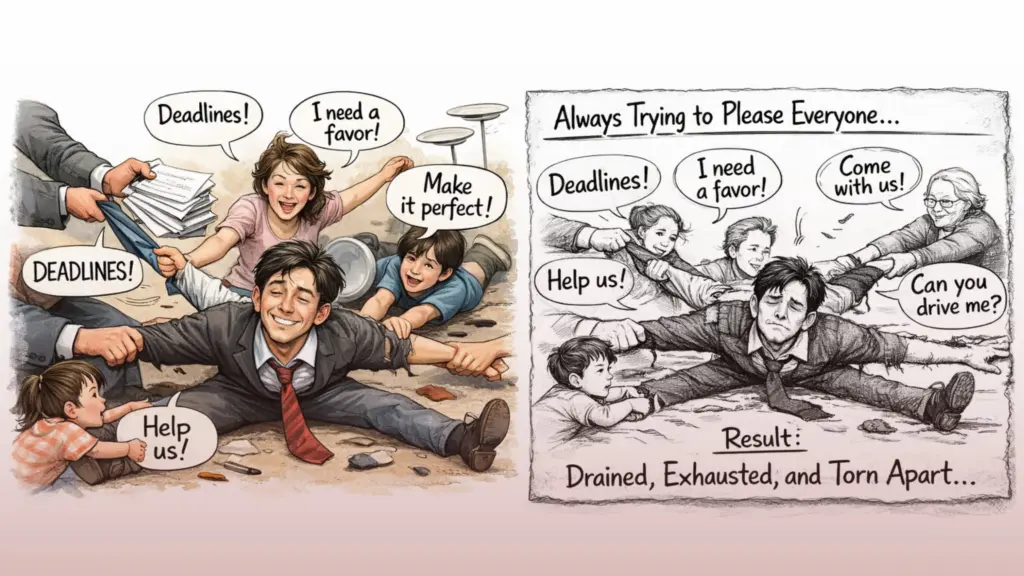
One of the greatest benefits of meditation is the transition from reactive mode to a more conscious state of awareness. In reactive conditions, the nervous system operates in a survival pattern. Movements become more tense. Breathing becomes shorter. Handwriting may also appear more inconsistent.
In contrast, in a reflective state the body and mind work more harmoniously. Hand movements become more controlled and the rhythm of writing becomes more stable. This is why understanding handwriting cannot be separated from understanding mental states. Writing is not merely a technique, it is also a neurological and emotional trace.
From Reactive to Reflective
Mature expression is not about appearing perfect. It is about balance. Balance between thoughts, emotions and actions. Therefore, everything can begin with something simple. Meditation helps us become more aware of ourselves, while handwriting allows us to observe the results of that awareness. When both are understood together, we are not only learning about handwriting but we are also learning about ourselves.
Understanding the relationship between meditation and handwriting can open a deeper perspective on how our inner state shapes the way we express ourselves.
Are you curious about how your inner state influences the way you express yourself through handwriting? Perhaps it is time to explore it more deeply, not only as a technique, but as a practice of awareness. Unlock a deeper understanding of your inner architecture. Join the Applicative Course at Karohs School and start your journey today.