The animated film Howl’s Moving Castle by Hayao Miyazaki is not only a fantasy story about magic and war. Behind its heartwarming visuals, the film also reflects the theme of emotional expression. Through moments of fear, love, ego, growth and the courage to change.
Through three main characters Howl Pendragon, Sophie Hatter and Calcifer, we can see how emotional expression shapes identity. Interestingly, if emotions are an inner language, handwriting can become one of its visual forms.
However, it is important to note that this reflection is meant for enjoyment, to explore the connection between handwriting and emotional expression in this animated film, not as a scientific analysis.
The Character of Wizard Howl
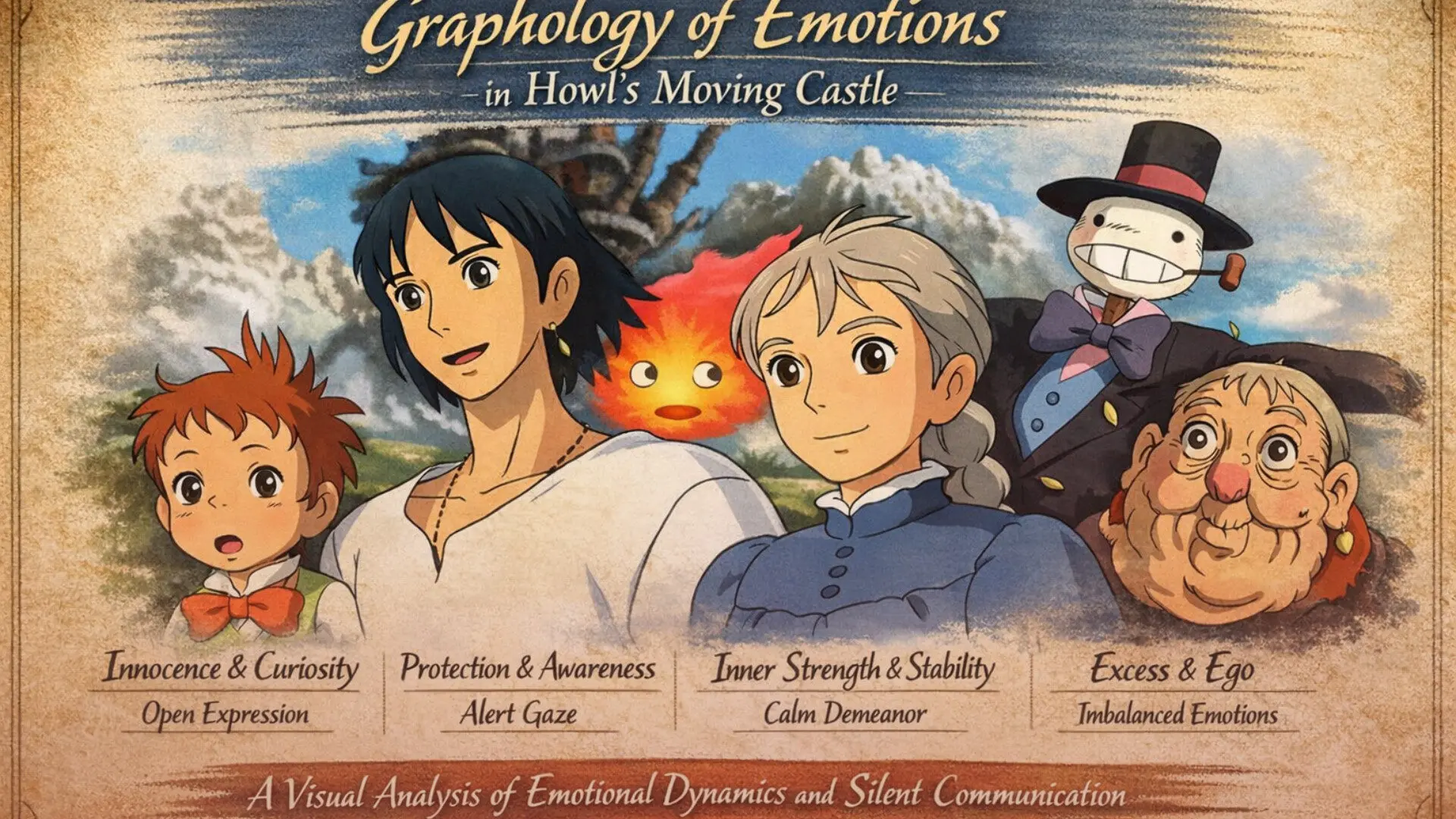
Howl is known as a charismatic, intelligent, and charming wizard. Yet behind his confident image, he is deeply sensitive. He fears loss, fears attachment, and often avoids direct confrontation. More precisely, he struggles with trust issues caused by his past experience with the Witch of the Waste. In several scenes, we even see his dramatic and emotionally explosive side.

Howl and his handwriting
If Howl’s character were reflected through handwriting, it might show small hooks at the end of strokes. These hooks can symbolize someone who tends to hold on tightly to what they have. Howl does not want the people he cares about to get hurt. Because of that, he chooses to protect them, even if it means he gets hurt instead.
This suggests a personality with strong emotional intensity but fluctuating stability. In handwriting observation, hooks at the end of letters are often associated with someone who is emotionally sensitive in protecting what they value. Howl is not cold. He is simply still learning how to stabilize his emotions.
The Character of Sophie
In contrast to Howl, Sophie appears simple and modest at the beginning of the story. She sees herself as ordinary and lacks confidence. However, after the curse that turns her into an old woman, her inner strength begins to appear.
Sophie learns to accept her situation. She does not focus on fear. Instead, she focuses on small actions she can control such as cleaning the castle, caring for others, paying attention to details. Through these simple actions, her emotional maturity grows.

Sophie and her handwriting
Sophie shows courage, if reflected in handwriting, this could appear in a connected letter “b” with a straight vertical stroke from top to bottom, rather than a curved one. This type of stroke can suggest confidence and firmness in decision-making. It reflects someone who believes in themselves and moves forward without hesitation.
Interestingly, Sophie’s age changes according to her emotional state. When she feels confident, she appears young again. When she doubts herself, she becomes old. This reflects the idea that psychological conditions influence physical expression. In real life, such expressions can sometimes be seen in handwriting as well.
The Character of Calcifer
Calcifer, the small fire that powers the castle, represents raw energy and emotion. He reacts quickly, expresses himself freely, and can be dramatic. Yet behind his humor, he also carries deep attachment.

Calcifer and his handwriting
If Calcifer had handwriting, it would likely appear fast and dynamic. He would not be patient with slow movements. His writing might also show an open in “a” and “o”, a letter that does not fully close. This feature is often associated with talkative tendencies and openness in expressing ideas, whether or not others are listening. Just like Calcifer and his constant comments.
Calcifer represents spontaneous emotion, unfiltered and immediate. Fire can warm, but it can also burn. However, like Calcifer, impatience and talkativeness are not negative traits by themselves. They simply need direction.
Emotion Is a Language. Handwriting Is Its Trace.
Howl’s Moving Castle is more than a fantasy story. It reflects on how Howl learns responsibility. Sophie discovers courage. Calcifer understands connection.
Emotion shapes response. Response shapes thinking patterns and thinking patterns often leave traces in handwriting. When someone feels anxious, their writing may change. When someone feels emotionally stable, their writing structure tends to become more consistent.
This film reminds us that everyone has their own inner “castle.” It can move, shift and sometimes feel unstable. But when we understand our emotions, we can guide them instead of being controlled by them.
Perhaps one simple way to begin that understanding is by observing how we write. Because behind every stroke, there is a story about how we respond to the world. Interested in exploring how your handwriting reflects your emotional expression? It may be time to understand yourself more deeply by joining the Sunday Lesson here.