When Pleasing Others Becomes a Habit
Many people grow up learning how to adapt. Adjusting tone, choosing words carefully and placing others first often feels like the easiest way to maintain harmony. In people pleasing handwriting, this habit may extend beyond behavior and quietly surface in unconscious movements, such as handwriting.
However, if someone constantly prioritizes others, it can be emotionally draining. The effort to stay agree and responsive in everything, may slowly pull attention away from personal needs. What often goes unnoticed is that this pattern does not only appear in behavior. It can also manifest in small things, unconscious movements, such as handwriting. Because sometimes, what we don’t say, can appear in how we write.
Understanding People Pleasing as an Emotional Pattern in Handwriting
People pleasing is not a flaw. It is often associated with empathy, emotional sensitivity and strong awareness of social signal. Sometimes, these traits can be linked to a deep need for acceptance, a fear of conflict or an instinct to keep emotional balance within relationships.
This tendency usually develops subconsciously. Rather than being a conscious choice, pleasing others often becomes an automatic response shaped by personal experience. As a result, the body learns to adapt quickly, sometimes faster than the mind can comprehend.
Handwriting as a Quiet Expression of People Pleasing Tendencies
In handwriting analysis, people pleasing tendencies often appear not only in behavior, but also in subtle writing patterns that reflect emotional adaptation. Handwriting is created through continuous coordination between the brain, emotions and motor movement. Because writing is not fully controlled, it often reflects internal states which are difficult to articulate verbally.
When a person repeatedly adapts to meet others’ expectations, this tendency to over adjust may subtly show up in their handwriting. As in graphology, such marks are not considered diagnostic or permanent traits, but rather reflections of a person’s emotional patterns at a given moment.
Handwriting Features Often Associated with People Pleasing Tendencies
Certain handwriting features are often linked to people pleasing patterns in handwriting, especially when they appear consistently and in combination.
1. Right Margin
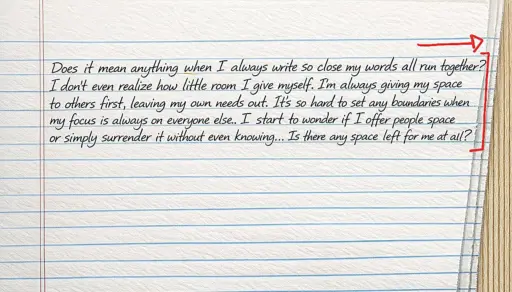
writing with margins that lean to the right
A handwriting pattern that leans closely toward the right margin often symbolizes limited personal space. This tendency may reflect an outward orientation for instance, an attention directed toward others, their responses and the expectations surrounding social interaction.
When the right margin becomes excessively narrow, it can suggest emotional availability that leaves little room for rest or self-prioritization. Rather than indicating generosity alone, this pattern may reflect a subtle habit of placing oneself in a constant state of readiness for others who being present and responsive, yet rarely pausing to attend to personal needs.
2. Word Spacing
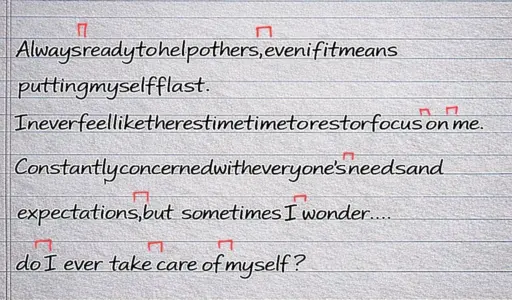
writing with narrow spacing
Similarly, handwriting with very narrow spacing between words can reflect minimal space reserved for oneself. Closely packed writing may suggest a tendency to give personal space to others without first considering one’s own need for it.
In such cases, emotional boundaries may feel easily crossed, not necessarily because they are unimportant, but because attention is consistently directed outward. The question becomes whether space is consciously shared or unconsciously surrendered in the effort to prioritize others.
3. Letter Size
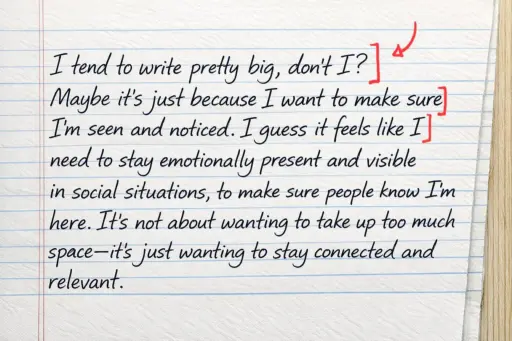
writing in large letters
Letter size often reflects how much space a person allows themselves to occupy. Larger writing can offer insight into a strong orientation toward social engagement and visibility. Within people pleasing patterns, this may appear as an effort to remain noticeable or emotionally present in social settings to ensure one’s presence is felt and acknowledged by others. Rather than indicating excess, this tendency can reflect how emotional energy is invested in maintaining connection and relevance.
A Pause of Self-Reflection
Do you give yourself enough space to pause before responding?
Do you feel comfortable setting boundaries without guilt?
In this way, handwriting can serve as a small reflection of how we relate to others and to ourselves. This can lead us to reflect on whether our actions arise from conscious choice or long-standing adaptive habits.
Awareness Before Change
The desire to please others is not inherently wrong. In fact, it often stems from a sense of caring, empathy and a desire for connection. Emotional maturity develops when we learn to recognize our own boundaries alongside the needs of others. Through understanding these patterns, then, it isn’t about judging ourselves. Yet it’s about clarity and establishing boundaries.
By observing these signs, people pleasing handwriting becomes a gentle mirror of how we manage boundaries, connection, and self-awareness. Handwriting can reveal emotional patterns we often overlook. Willing to learn to read them with deeper awareness? Through the Applicative Course by Karohs School you can develop balance, insight and personal mastery through writing.