Ellie’s handwriting in The Last of Us Part II offers a quiet glimpse into how she processes her world. In a world defined by loss and survival, words are rarely spoken without weight. In the game, silence often carries as much meaning as dialogue. What remains unspoken matters just as much as what people say. Amid abandoned buildings and fading memories, small traces of humanity still persist. A joke written in a notebook. A few scattered lines on a worn piece of paper. These fragments may seem insignificant at first glance, yet they still hold something deeper.
Ellie Williams is not only a survivor of a broken world. She is also someone who continues to observe, to question and to process everything around her. Sometimes, that process appears in the simplest form. Through her handwriting, Ellie’s notes are often brief. Sometimes unfinished, as if written in passing. It creates a sense of immediacy, capturing thoughts before they disappear.
The writing does not feel overly constructed. It follows thought as it comes. This creates an impression of directness where expression is not delayed, but allowed to appear in its raw form.
Ellie’s Writing Traits
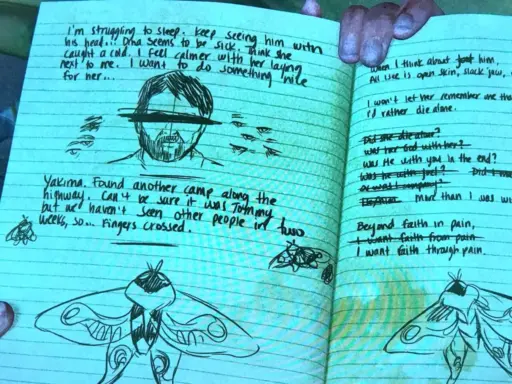
Ellie’s handwriting
At the same time, her writing is not entirely open. There are moments where it feels contained, as if certain thoughts are expressed while others are held back. This creates a balance between spontaneity and control. A pattern often seen in individuals who do not immediately trust what they experience, but take time to filter and evaluate it.
If observed through a handwriting lens, we can associate Ellie’s writing with Investigative Traits. Her writing often indicated by sharper, more angular formations, especially at the upper zones of letters such as M and N.
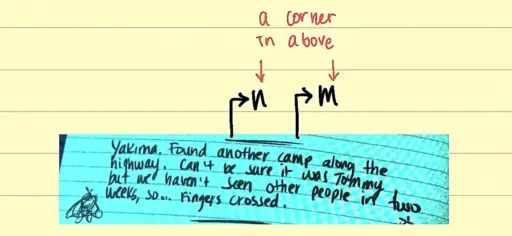
Investigative Traits
This angularity reflects a cognitive tendency to question rather than accept. Individuals with this pattern are less likely to take information at face value. They tend to seek clarity, evidence and direct experience before forming conclusions.
In Ellie’s context, this aligns with how she navigates her world. She does not rely solely on what is told to her. She observes, verifies and often needs to see things for herself before fully trusting them.
Writing as a Way of Processing
Growing up in an environment where certainty is rare, Ellie learns to process internally. Writing becomes one of the spaces where that process takes place. Her notes may be short, but they carry weight. She does not explain everything, but something is always being worked through, quietly.
What makes her writing compelling is not only what appears on the page, but what remains unsaid. There are pauses. Incomplete thoughts. Moments where expression stops just before it fully forms. This reflects a space between experiencing and concluding. It’s where observation is still ongoing. Ellie’s handwriting is not about perfection. It is about awareness.
It reflects a mind that does not immediately settle, but continues to question, observe and seek understanding. In a world where certainty is fragile, that process becomes a way to stay grounded. Sometimes, expression is not about having all the answers. It is about leaving a trace that says:
“I was here. I saw this. I’m still trying to understand.”
And perhaps, in your own way, you leave traces like that too. Sunday Lesson is where you begin to notice them.