War does not always end when someone comes home. Sometimes, it continues quietly through memory, fear and the way a person begins to see the world differently. In Brothers, Sam Cahill introduced as a disciplined Marine, a responsible father and a husband who deeply cares about his family. Before leaving for Afghanistan, Sam appears emotionally structured. He believes in duty, protection and stability. His relationship with his wife, Grace, and his daughters becomes one of the emotional centers of the story.
However, everything changes after the war.
After being presumed dead and eventually returning home, Sam no longer feels like the same person. The experience of survival, trauma and psychological pressure slowly reshape the way he responds to the people around him. Conversations become tense. Trust becomes fragile. Small situations quickly turn into emotional conflict.
The film does not only show physical survival. It shows what happens when someone returns home carrying experiences they can no longer fully explain. Interestingly, some of these emotional patterns can also be reflected symbolically through handwriting.
Sam’s Need to Hold On (Tenacity Traits)
If observed through a handwriting perspective, Sam’s writing can be associated with Tenacity Traits, often indicated by hooks appearing at the end of letter strokes.
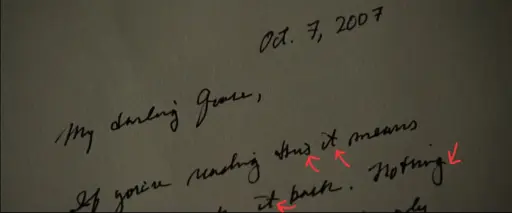
tenacity traits
This hook formation reflects a tendency to hold tightly to what someone already has. Individuals with this pattern often show emotional attachment toward people, relationships or responsibilities they consider important.
In Sam’s case, this can be seen through how strongly he tries to protect his family, especially his relationship with Grace. Even after returning from war, much of his emotional reaction comes from fear of losing what he believes still belongs to him. The stronger the emotional attachment becomes, the harder it can feel to let go. Sometimes, protection and fear begin to overlap.
Aggressive Traits
At the same time, Sam also displays emotional tension that becomes increasingly difficult to control after returning home. In handwriting analysis, this can be associated with Aggressive Traits, often shown through sharp angular formations in the lower zone of writing.
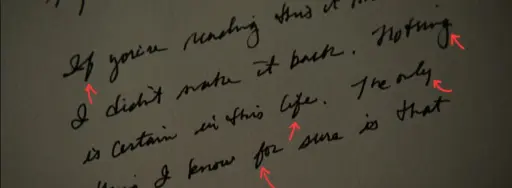
aggressive traits
This pattern is commonly linked to defensive emotional reactions, difficulty trusting others and a tendency to respond as if conflict is already approaching even when no direct threat exists.
This becomes visible in Sam’s behavior after returning home. He grows suspicious toward Grace and his younger brother, Tommy, believing they may have betrayed him emotionally during his absence. Conversations quickly escalate into arguments. His responses become confrontational, as if he constantly feels the need to defend himself or regain control.
The aggression shown in the film is not presented as simple anger. It feels closer to unresolved fear searching for certainty.
Impatience Traits
Another pattern that can symbolically relate to Sam is Impatience Traits, often reflected through the placement of the dot on the letter “i” being pulled toward the right.
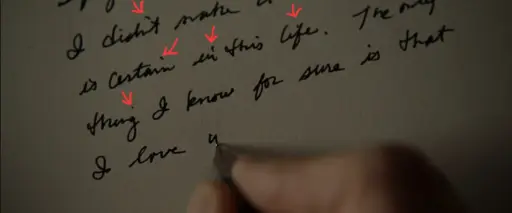
impatience traits
This tendency is commonly associated with difficulty tolerating delays, slow processes or situations that feel mentally overwhelming.
One moment that reflects this appears during a family dinner after Sam returns home. While everyone is gathered for Maggie’s birthday, the sound of Isabelle repeatedly playing with a balloon begins to disturb him. What seems small to others quickly becomes unbearable for Sam, until he suddenly explodes in anger toward his daughter.
The reaction feels larger than the situation itself. It reflects how internal pressure can reduce emotional tolerance, making even ordinary moments feel overwhelming.
When Expression Changes After Trauma
What makes Brothers emotionally powerful is not only the conflict itself, but the gradual transformation within Sam. He returns physically, but psychologically, part of him remains trapped in survival mode. The film quietly shows how trauma can affect emotional regulation, trust and interpersonal relationships.
Through a reflective handwriting lens, these patterns can symbolically appear through tension, hooks, sharp formations and movement within writing. Not as judgment, but as traces of an internal process that is still struggling to stabilize itself.
Because sometimes, handwriting is not only about how someone writes. It can also reflect how someone is carrying their experiences. And in Sam’s case, the page seems to carry the weight of survival long after the war is over.
Some experiences leave traces long after the moment has passed. Through the Comprehensive Course at Karohs School, learn how handwriting can help you observe inner tension and the way life experiences quietly shape human expression beyond words alone.