What This Article Helps You See
- Productive early practice begins with accurately describing what is visible before assigning possible meaning.
- Comparing samples and recording observations can build a more disciplined foundation than collecting isolated trait labels.
- Self-study can prepare your attention and vocabulary; structured learning becomes essential when interpretation and judgment begin.
You notice that a friend’s writing appears tense, very neat, or unexpectedly uneven. The natural question is whether to observe it, compare it with other writing, or immediately search for a meaning. If you want to practice handwriting analysis before taking a course, begin with observation rather than conclusions.
Early practice can be genuinely useful when it helps you see form, variation, and context more carefully. It cannot, by itself, establish professional competence or justify confident judgments about a writer. The constructive aim is to build an attentive eye, a precise vocabulary, and habits that will support later structured learning.
What productive pre-course practice can include
A beginner can practice handwriting analysis productively by learning to separate what is on the page from what they think it may suggest. Description concerns observable features: the overall size of writing, its slant, spacing, baseline movement, margins, pressure appearance, speed cues, and the relationship between letters. Interpretation asks how a pattern might be understood within a wider system. These are different tasks.
At this stage, treat a sample as material for careful observation, not a shortcut to defining someone. A single feature can arise for many reasons, including writing conditions, a rushed moment, a particular pen, physical comfort, language habits, or ordinary variation. Even repeated features need to be considered alongside the rest of the writing and the circumstances in which it was produced.
This distinction protects your learning. It prevents the tempting but unreliable habit of seeing one narrow letter or one heavy stroke and attaching a fixed personal label to it. Early practice is successful when your descriptions become more accurate, not when your interpretations become more dramatic.
How to practice handwriting analysis with simple exercises

Choose writing that you have permission to use, preferably ordinary notes produced naturally rather than highly staged samples. Avoid treating private writing as material to inspect without consent. Keep the activity modest and educational: you are learning to notice visual evidence, not making decisions about another person.
Describe one sample without interpreting it
Set a short timer and write down only what you can point to. You might note that the writing is medium-sized, mostly right-slanted, closely spaced, and uneven along the baseline. If a statement begins with “this means,” pause and rephrase it as a visible observation. This exercise develops the discipline to distinguish evidence from assumption.
Compare two or three samples
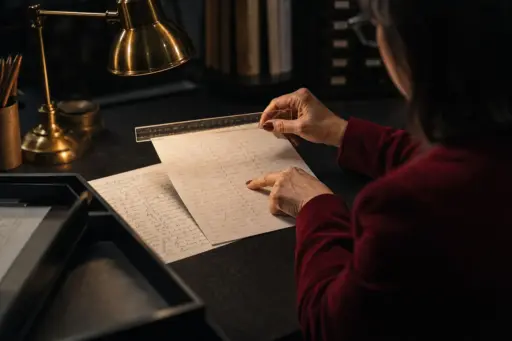
Next, place samples side by side and look for differences and continuities. Are word spaces similar? Does the slant remain broadly stable? Is the writing more compressed in one note than another? Comparison helps you notice that handwriting is not a collection of disconnected signs. It is an organized movement on a page, with patterns that may hold steady or change according to situation.
You can also compare two passages from the same writer, provided both are shared appropriately. Record what remains consistent and what shifts. Do not assume a shift has one explanation. Instead, list plausible contextual questions: Was one passage written quickly? Was the surface different? Was the writer copying text or composing freely?
Check consistency within the page
Move from the first line to the middle and then the ending. Notice whether spacing, line direction, size, or pressure appearance changes. A useful observation log distinguishes “present throughout,” “mostly present,” and “appears only in places.” This is more valuable than treating the first feature you notice as the whole story.
A simple sample log can include the date, writing conditions if known, broad visible features, variations, and questions for later study. Keep conclusions out of the log, or clearly label them as tentative. The record gives your future learning something concrete to revisit. It can also reveal how easily first impressions change when you look again.
Why memorizing meanings too early creates confusion

Online content often presents handwriting analysis as a list of quick associations. Such lists may give beginners vocabulary, but they can encourage premature certainty when used without a method. Naming a feature is not the same as weighing it, and weighing it is not the same as reaching a responsible interpretation.
Consider this hypothetical example. Maya sees a page with a rightward slant, tight word spacing, and darker pressure in several lines. Rather than deciding what these details reveal about the writer, she records each observation, checks whether it is consistent across the page, and notes that the last lines appear more hurried. She has practiced the most important first step: keeping the visible sample and her possible explanation separate.
As your vocabulary grows, retain that pause. Ask whether a feature is dominant or incidental, repeated or occasional, and supported or contradicted elsewhere in the sample. A responsible approach to learning handwriting analysis responsibly places patterns in context rather than turning isolated details into verdicts.
Where solo practice reaches its limit

Independent observation has clear limits. You may be able to identify forms, but you may not yet know which patterns deserve more weight, how apparently conflicting features can coexist, or how to distinguish a meaningful pattern from a writing-condition effect. These are questions of method and judgment, not merely attention.
Self-practice can also reinforce errors if there is no framework for correction. A learner may repeatedly apply the same appealing interpretation because it sounds plausible, while overlooking the broader organization of the sample. This is why early notes should remain provisional and why handwriting analysis should be treated as a complementary perspective, never as a basis for diagnosis, hiring decisions, or claims about a person’s worth.
When you find yourself wanting to explain people rather than describe writing, it is a good sign to slow down. The next useful step is not more guessing. It is a learning environment that explains interpretive hierarchy, context, ethics, and the relationships among features. For a wider view of why a disciplined pathway matters, read about structured study in handwriting analysis.
When a course adds real value

A course becomes especially valuable when you want feedback on your observations, a sequence for building concepts, and a way to test your reasoning against a coherent method. Structured learning can show you how to move from broad form to finer details, how to compare patterns without overreading them, and how to communicate observations with appropriate restraint.
That does not make your preparatory exercises wasted time. On the contrary, a well-kept observation log and the habit of looking twice can make formal instruction more meaningful. You arrive ready to ask better questions and to recognize why method matters. If you are considering a more committed foundation, KAROHS also explains what serious beginners should expect from training.
Start now, but start honestly. Observe with permission, compare carefully, document uncertainty, and resist the pressure to produce instant answers. Those habits create a sound bridge between beginner curiosity and responsible handwriting analysis learning.
Questions About This Topic
Can I practice handwriting analysis on my own without mislearning it?
Yes, if you keep your practice descriptive and provisional. Work with permission, record visible features, compare samples, and avoid fixed personality conclusions. Solo practice is useful for attention and vocabulary, but it does not replace guided correction or a structured interpretive method.
What should I observe first in a handwriting sample as a beginner?
Begin with the overall picture: size, page layout, slant, spacing, baseline direction, writing rhythm, and visible variation. Describe what appears on the page before focusing on individual letters or searching for possible meanings.
How do I know when free practice is no longer enough?
Free practice has reached its limit when you are unsure how to weigh multiple features, encounter apparently conflicting signs, or feel drawn to make confident personal judgments. At that point, structured training can provide method, feedback, ethical boundaries, and a clearer order of interpretation.
Should I use friends’ handwriting for beginner exercises?
Only with their clear permission and with respect for privacy. Use samples as anonymous observation material where possible, do not share them casually, and do not present your notes as judgments about the person.
Study Handwriting Analysis with KAROHS
When you are ready to move from careful observation to a disciplined method, KAROHS courses offer a structured route for learning handwriting analysis with context, ethical boundaries, and professional guidance.